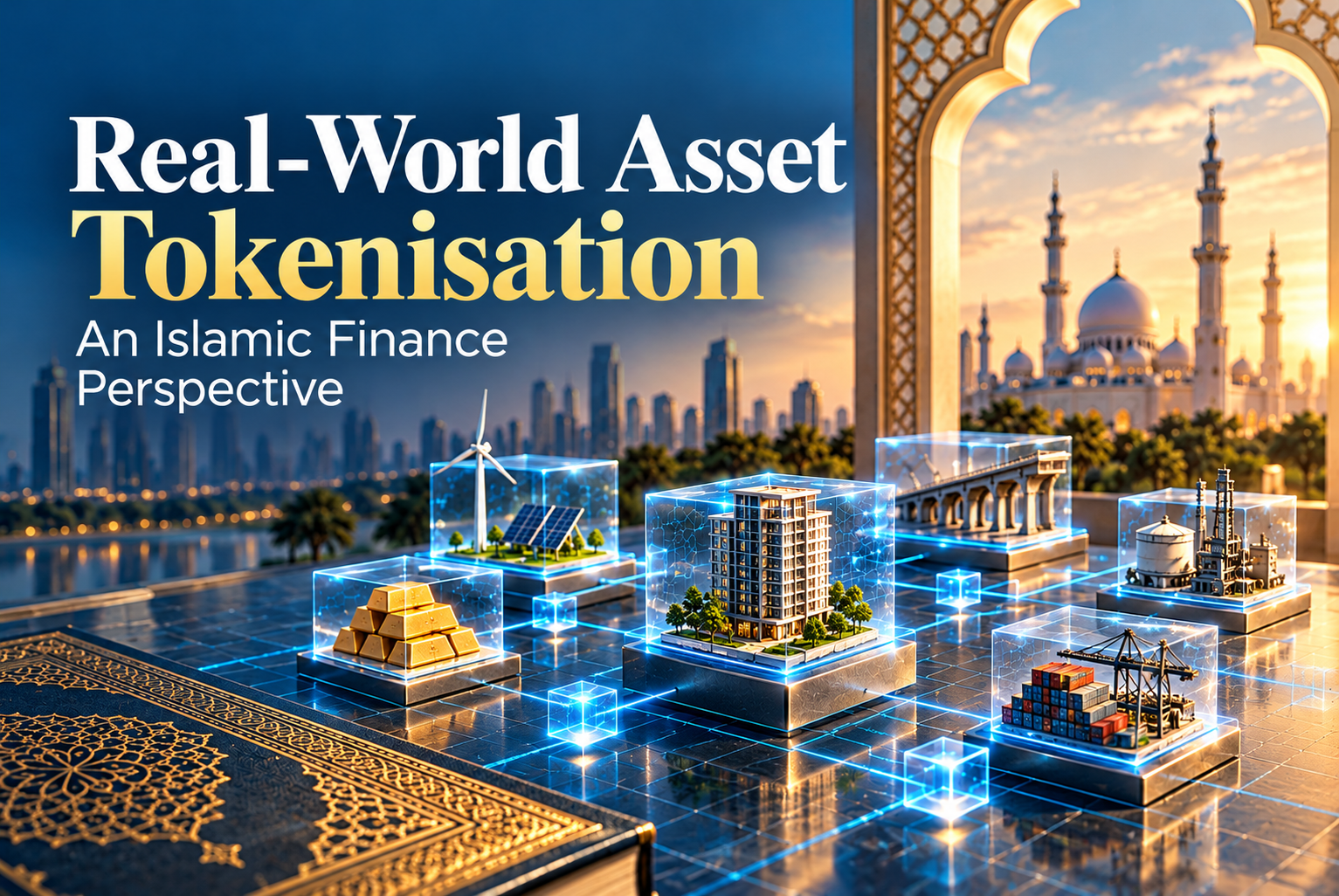
Real-World Asset Tokenisation: An Islamic Finance Perspective
Real-World Asset Tokenisation: An Islamic Finance Perspective
The financial world is rapidly moving towards tokenisation—the process of representing assets and financial rights digitally using blockchain technology.
From real estate and infrastructure to commodities and investment instruments, Real-World Asset (RWA) tokenisation is emerging as an important development in digital finance.
For Islamic finance, this development is particularly interesting.
Islamic finance has always emphasised the relationship between financial transactions and genuine economic activity. Tokenisation, when properly structured, could provide new technological infrastructure for representing ownership, improving transparency and widening access to Shariah-compliant investments.
But does putting an asset on blockchain automatically make it Shariah-compliant?
The answer is no.
What Is a Real-World Asset?
A Real-World Asset, commonly abbreviated as RWA, is an asset or economic right that exists outside the blockchain but can be digitally represented within a blockchain-based system.
Examples may include:
-
Real estate
-
Infrastructure
-
Machinery and equipment
-
Commodities
-
Trade receivables
-
Investment funds
-
Shariah-compliant securities
-
Sukuk
-
Renewable-energy assets
Tokenisation creates a digital representation connected to the underlying asset or associated legal rights.
For example, instead of recording an investment interest exclusively through a conventional database, an authorised digital token could represent that interest on a blockchain.
What Is Asset Tokenisation?
Asset tokenisation is the process of converting rights associated with an asset into digital tokens.
Suppose a commercial property has an investment value of RM10 million.
Under an appropriately structured legal and regulatory framework, interests in that property could potentially be divided into smaller digital units.
Investors could then acquire eligible units rather than having to finance the entire property.
The blockchain can maintain records of token ownership and transactions.
However, an important distinction must be made:
Owning a token does not automatically mean legally owning the underlying asset.
The rights represented by a token depend on the contractual structure, legal documentation, jurisdiction and regulatory framework supporting it.
This distinction is extremely important in Islamic finance.
Why RWA Tokenisation Is Relevant to Islamic Finance
Islamic finance is built upon principles including fairness, transparency, contractual certainty and connection with legitimate economic activities.
Many Islamic financial structures already involve identifiable assets, usufruct, partnerships, commodities or commercial activities.
This creates a potentially natural relationship between Islamic finance and asset tokenisation.
Instead of creating purely speculative digital instruments, blockchain can be used to represent legitimate economic rights associated with real assets.
The objective should therefore not simply be:
“Put an asset on blockchain.”
A more important question is:
“What exactly does the token represent?”
This question is both technologically and Shariah significant.
The Importance of Ownership
Ownership is one of the most important considerations in RWA tokenisation.
A digital token could represent different things.
It might represent direct ownership, beneficial ownership, an investment interest, a contractual entitlement, usufruct, participation in a partnership or another legally recognised right.
These are not necessarily equivalent.
For Islamic finance, scholars and structuring professionals must therefore examine the substance of the arrangement.
Questions may include:
What does the investor actually own?
Who owns the underlying asset?
What rights does the token provide?
How are profits generated?
Who bears the relevant risks?
Can the token be transferred?
What happens if the issuer becomes insolvent?
Blockchain can record transactions, but it cannot independently resolve these legal and Shariah questions.
Tokenisation Does Not Automatically Create Shariah Compliance
A common misconception is that an asset-backed token is automatically Shariah-compliant.
This is incorrect.
Shariah compliance depends on the complete structure of the transaction.
The underlying asset or activity must be permissible, and the contractual relationships must comply with relevant Shariah principles.
A structure should also avoid prohibited elements such as riba, excessive gharar and maysir.
For example, tokenising an interest-bearing conventional debt instrument does not transform it into an Islamic financial product merely because blockchain is used.
Technology changes the method of recording and executing transactions.
It does not change the underlying Shariah character of those transactions.
Fractional Ownership and Financial Inclusion
One potential benefit of tokenisation is fractionalisation.
Certain assets traditionally require substantial capital.
Commercial property, infrastructure and large investment projects may therefore be difficult for smaller investors to access.
Tokenisation can technically divide economic interests into smaller units.
For example:
Asset Value: RM5,000,000
Tokenised Units: 50,000
Indicative Unit Value: RM100
This does not mean every RM5 million asset can immediately be offered to the public in RM100 units. Securities laws, investor-protection rules, offering requirements and other regulations may apply.
However, the technology demonstrates how fractionalisation could potentially lower operational barriers to participation where legally permitted.
This creates interesting possibilities for Islamic financial inclusion.
RWA Tokenisation and Sukuk
Sukuk may become one of the most important applications of RWA tokenisation in Islamic capital markets.
Depending on its Shariah structure, a Sukuk may represent interests connected with assets, usufruct, investment activities or projects.
Digital tokens can potentially be used as the technological representation of eligible investor interests.
A simplified structure could look like:
Real-World Asset → Shariah Structure → Sukuk → Digital Token → Eligible Investor
Blockchain can then potentially support ownership records, investor verification, transfer controls, distributions and reporting.
This combination is often referred to as Digital Sukuk or Tokenised Sukuk.
Smart Contracts and Automated Finance
Smart contracts add another dimension to RWA tokenisation.
A smart contract is software deployed on a blockchain that executes predefined instructions when specified conditions are satisfied.
In a Shariah-compliant investment structure, smart contracts could potentially assist with:
-
Investor eligibility checks
-
Token issuance
-
Transfer restrictions
-
Ownership records
-
Distribution calculations
-
Redemption processes
-
Compliance controls
-
Transaction reporting
For example, a token could be programmed so that it can only be transferred to a wallet belonging to an approved investor who has completed the required KYC process.
This creates the possibility of programmable compliance.
The Role of Shariah Governance
Shariah governance remains essential even when processes become automated.
Scholars and Shariah advisers need to understand not only the legal documentation but also how the technology implements the approved structure.
Consider a smart contract programmed to distribute investment returns.
The important question is not simply whether the software correctly performs the calculation.
The underlying questions include:
Where did the return originate?
Was the underlying activity permissible?
Does the distribution follow the agreed Shariah contract?
Are ownership and risk properly allocated?
A technically perfect smart contract could still execute a transaction that is inconsistent with the intended Shariah structure if the rules encoded into it are incorrect.
Therefore, Shariah governance should extend into the digital architecture itself.
Transparency and Traceability
Blockchain can also improve transparency.
Depending on the system design, authorised participants may be able to examine transaction histories, token movements and ownership records.
This can potentially assist issuers, trustees, auditors, regulators and Shariah advisers.
For Islamic finance, better traceability could also strengthen ongoing Shariah monitoring.
Instead of reviewing only periodic reports, future systems could potentially provide more continuous visibility into certain transactions and asset movements.
This could contribute to a new area of technology-enabled Shariah governance.
Challenges of RWA Tokenisation
Despite its potential, RWA tokenisation presents significant challenges.
One major issue is the relationship between the blockchain token and the legal ownership of the underlying asset.
Other challenges include:
-
Regulatory treatment of tokenised securities
-
Digital asset custody
-
Cybersecurity
-
Private-key management
-
Investor protection
-
Asset valuation
-
Secondary-market liquidity
-
Cross-border recognition
-
Data privacy
-
Shariah governance
-
Smart-contract risk
There is also the fundamental question of what happens when information recorded on blockchain conflicts with legally recognised records outside the blockchain.
These issues require collaboration between regulators, lawyers, financial institutions, Shariah scholars and technologists.
Beyond Cryptocurrency
Blockchain is frequently associated with cryptocurrency.
However, RWA tokenisation demonstrates that blockchain has broader applications.
The technology can function as infrastructure for recording ownership, enforcing transaction rules, automating processes and connecting financial instruments with real economic assets.
For Islamic finance, this distinction is particularly important.
The objective does not have to be the creation of another speculative digital token.
Instead, blockchain can potentially become infrastructure for asset-based, transparent and programmable Islamic finance.
The Future of Tokenised Islamic Finance
The convergence of Islamic finance and tokenisation could eventually support new models for property investment, infrastructure financing, renewable energy, trade finance, Sukuk, Waqf and other Shariah-compliant economic activities.
The most successful solutions, however, will probably not be those that simply add the word “blockchain” to an existing financial product.
They will be those that successfully integrate:
Real Economic Assets + Shariah Principles + Legal Rights + Regulation + Digital Technology
This combination is much more powerful than tokenisation alone.
Islamic finance already provides a framework that emphasises ethical economic activity, contractual responsibility and links between finance and real assets.
Blockchain provides a new technological infrastructure through which some of these principles can potentially be implemented with greater transparency and efficiency.
The opportunity is therefore not merely to digitise Islamic finance.
It is to build a digital financial ecosystem in which technology supports the values and principles that Islamic finance was designed to uphold.
Tags :